The short answer: three things decide it, in this order. First the room, meaning ceiling height, free floor space and whether a certified rigging point exists. Second the occasion and the role the act is meant to play in the programme. Third the audience and the time of day. Anyone who knows these three can narrow the choice down to two or three acts within minutes.
Aerial acrobatics needs height and a load-bearing point, but rewards you with an intensity that works best up close. Ground acts such as Cyr Wheel work almost anywhere and are the most flexible choice. Character and comedy acts carry an evening dramaturgically, including with mixed audiences. Visual acts with light only come into their own after dark. Juggling and walking acts are the right call when there is no stage at all or the audience keeps moving.
Five questions to settle beforehand
Anyone who knows these five answers will get a solid quote from any artist instead of a follow-up question.
How high is the room, and is there a structurally certified rigging point?
How large is the free area available for the performance?
Is the event indoors or outdoors, and how bright will it be at performance time?
Should the act open the programme, deliver the highlight, or lighten the mood in between?
Is the audience local or internationally mixed?
The act categories at a glance
| Category | Suits | Minimum requirement | Typical duration |
|---|---|---|---|
| Aerial straps | Galas, theatre, venues with height | Rigging point from 5 m, 250 kg working load | 4 to 6 min. |
| Character act on a hat stand | Themed evenings, dinner shows, galas | Rigging point from 3 m, 250 kg working load | 4 to 8 min. |
| Cyr Wheel | Almost any format, indoors and outdoors | Level surface from 4 x 4 m | 4 to 6 min. |
| LED Cyr Wheel | Evening events, brand moments, arenas | Area from 3 m, dusk or darkness | 4 to 6 min. |
| Whip artistry | Cabaret, themed events, late-night slots | 5 x 5 m area, 3.5 m height, safety distance | 4 min. |
| Juggling | Receptions, stage programmes, street formats | Little space, often no stage needed | 5 to 15 min. |
| Walking acts | Receptions, trade fairs, moving audiences | No stage required | Several sets |
Which act suits a gala?
A gala calls for an act that fits into an existing evening programme without dominating it. The audience is seated, attention is focused, expectations are high.
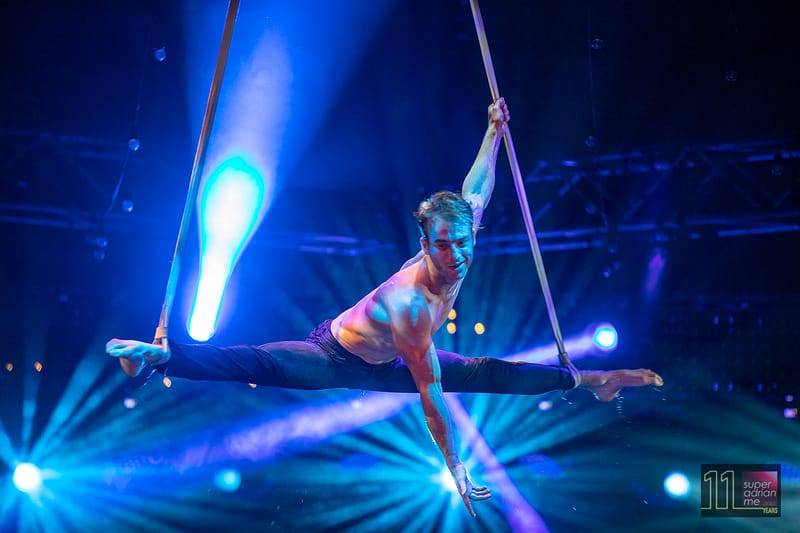
Aerial acrobatics and character acts work best here. Straps deliver the emotional peak, because the alternation of power and stillness creates a tension that is immediately palpable up close. A character act works better as an opener or as a moment between two programme points, because it draws the audience in rather than overwhelming them.
What often gets underestimated at galas: the role in the running order matters more than the discipline. The same act can work as an opener and fall flat as a finale. If in doubt, send the running order, not just the date.


Which act suits a 1920s themed evening?
Themed evenings in twenties style live on characters, not disciplines. A purely technical act, however good, remains a foreign body in that setting.
Character acts are the obvious choice here, especially those with costume, posture and a recognisable figure. A gentleman in a suit losing his grip on gravity at a hat stand tells a story in seconds that fits the evening. Whip artistry works similarly well, combining elegance with controlled danger and slotting easily into the era stylistically.
A practical advantage of both: the humour comes from movement and timing, not from language. With an internationally mixed audience, that is decisive.
Cyr Wheel can also be adapted through costume and music, but remains the visually more modern act. For a vintage evening it is the second choice.
Which act suits a sports event?
Sports galas, awards evenings and gymnastics festivals bring an audience that can judge body control. That is both an opportunity and a risk: weaknesses show, but genuine technique is genuinely appreciated.
Cyr Wheel is the strongest choice here. The discipline grew out of wheel gymnastics and has its own world championship, so it connects naturally with a sporting context. It also works on large surfaces, which sports halls and arenas usually provide.
Aerial acrobatics works too, but requires a load-bearing rigging point, which sports halls do not always offer. If no point is available, a freestanding rig can be brought along.
For arena formats with lighting design and darkness, the LED Cyr Wheel is the most visually effective option, because it reads from a distance. That is an important difference from theatre stages: in an arena part of the audience sits far away, and fine detail is lost there.
Which act suits a modern event or brand moment?
At product launches, kick-offs and brand events, every programme point competes with the actual message. An act should therefore not only entertain but reinforce the brand.
Visual acts with programmable light are best suited to this. With the LED Cyr Wheel, colours, patterns, lettering and logos can be built directly into the wheel’s light programme. What the audience sees then does not look like a bought-in programme point, but visibly belongs to the presentation.
Two conditions apply: it needs to be dark enough, otherwise the effect loses its impact, and the enquiry should come early, because individual programming needs lead time.
If daylight is unavoidable, an act that works without light is the better choice, such as Cyr Wheel or juggling.
Which act suits receptions, trade fairs and formats without a stage?
Not every event has a stage, and not every audience stays seated. For receptions, exhibition stands and formats with ongoing activity, stage acts are the wrong choice, however good they are.
Walking acts and juggling have the advantage here. Walking acts move through the room, need no stage and no fixed start time. They create attention in waves rather than in a single peak. Juggling works in a small space, stays clearly visible and can be performed as a short stage number or in a walking format.
These are categories I do not offer myself. If your event calls for them, that is the more honest recommendation than a stage act that gets lost in the room.
What if the technical setup does not fit?
The most common obstacles and what can be done about them.
No rigging point available: for aerial acrobatics, a freestanding rig can be brought along and set up on site. The act then works independently of the ceiling structure.
Less than five metres of height: often still feasible. The character act on the hat stand needs only three metres, classic straps five. A quick enquiry with the exact measurements settles it faster than any table.
Small stage: Cyr Wheel has been performed on 2.40 metres in diameter. With adapted choreography, far more is possible than the technical ideal suggests. The only thing that matters is naming the measurements in advance, so the choreography can be adapted rather than improvised.
Unsuitable floor: carpet, large gaps and a noticeable slope are problematic for Cyr Wheel. Stage flooring, parquet and dance floors work well.
Outdoors: possible as long as the surface is level, dry and non-slip. In rain or strong wind the performance has to be moved or rescheduled for safety reasons. A backup plan therefore belongs in every outdoor plan.
Several acts in one evening
When an evening needs several programme points, combining different categories works better than three numbers from the same discipline. A ground act, an aerial act and a character act create three different kinds of tension.
There are practical arguments for booking several acts from one person: less coordination, one point of contact, one journey, and a common thread through the evening, because the same signature remains recognisable. Package pricing is available for multi-act bookings.
Frequently asked questions
Cyr Wheel. It works in daylight and in the dark, indoors and outdoors, on large and small surfaces, and needs no rigging point.
Acts whose effect comes from movement and timing rather than language. Character acts and aerial acrobatics work regardless of the audience’s linguistic background.
Between 20 and 60 minutes depending on the act. Ground acts are quicker, aerial acts need more time for rigging and safety checks.
A booking can be made at any time. The earlier the enquiry, the more likely your preferred date is still free. For individual logo programming, allow more lead time.
Costs are in the four-figure range. The main factors are travel, the number of performances and technical requirements.
You know your occasion, your room and your audience. Send me the date, location and event format, and I will recommend the right act and get you a concrete quote promptly.


)

