News

What’s New from Circus Artist Oscar Kaufmann?

A look behind the scenes of my life as a circus artist: clips and photos from shows, workshops and other engagements around the world, along with thoughts, tips and insights from me on everything to do with circus, stage and the world of events.

Which Show Act Suits My Event?

The short answer: three things decide it, in this order. First the room, meaning ceiling height, free floor space and whether a certified rigging point exists. Second the occasion and the role the act is meant to play in the programme. Third the audience and the time of day. Anyone who knows these three can narrow the choice down to two or three acts within minutes.

Aerial acrobatics needs height and a load-bearing point, but rewards you with an intensity that works best up close. Ground acts such as Cyr Wheel work almost anywhere and are the most flexible choice. Character and comedy acts carry an evening dramaturgically, including with mixed audiences. Visual acts with light only come into their own after dark. Juggling and walking acts are the right call when there is no stage at all or the audience keeps moving.

Five questions to settle beforehand

Anyone who knows these five answers will get a solid quote from any artist instead of a follow-up question.

How high is the room, and is there a structurally certified rigging point?

How large is the free area available for the performance?

Is the event indoors or outdoors, and how bright will it be at performance time?

Should the act open the programme, deliver the highlight, or lighten the mood in between?

Is the audience local or internationally mixed?

The act categories at a glance

Which show act suits which event: act categories, use, minimum requirements and duration
CategorySuitsMinimum requirementTypical duration
Aerial strapsGalas, theatre, venues with heightRigging point from 5 m, 250 kg working load4 to 6 min.
Character act on a hat standThemed evenings, dinner shows, galasRigging point from 3 m, 250 kg working load4 to 8 min.
Cyr WheelAlmost any format, indoors and outdoorsLevel surface from 4 x 4 m4 to 6 min.
LED Cyr WheelEvening events, brand moments, arenasArea from 3 m, dusk or darkness4 to 6 min.
Whip artistryCabaret, themed events, late-night slots5 x 5 m area, 3.5 m height, safety distance4 min.
JugglingReceptions, stage programmes, street formatsLittle space, often no stage needed5 to 15 min.
Walking actsReceptions, trade fairs, moving audiencesNo stage requiredSeveral sets

Which act suits a gala?

A gala calls for an act that fits into an existing evening programme without dominating it. The audience is seated, attention is focused, expectations are high.

Aerial acrobatics and character acts work best here. Straps deliver the emotional peak, because the alternation of power and stillness creates a tension that is immediately palpable up close. A character act works better as an opener or as a moment between two programme points, because it draws the audience in rather than overwhelming them.

What often gets underestimated at galas: the role in the running order matters more than the discipline. The same act can work as an opener and fall flat as a finale. If in doubt, send the running order, not just the date.
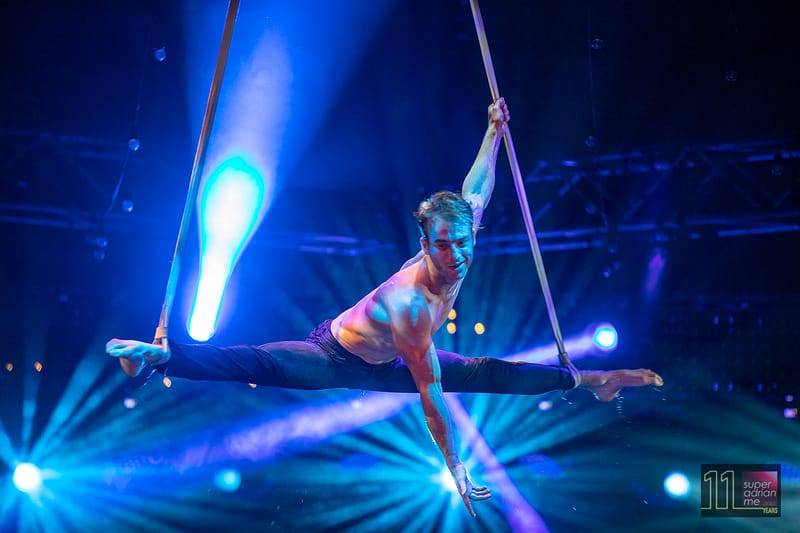
Oscar im Spagat in den Strapaten
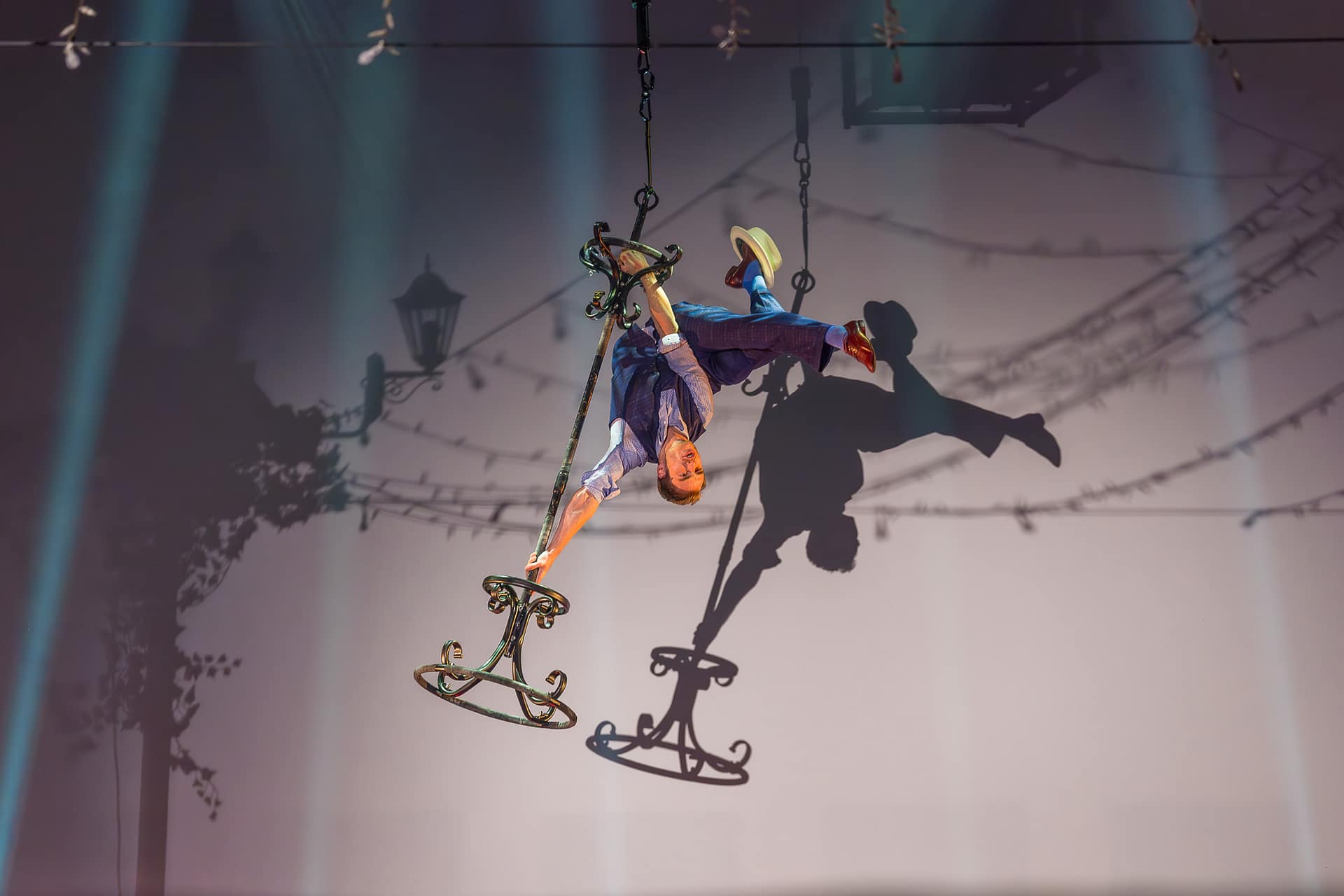
Flying Gentleman bei La Clique in Singapur
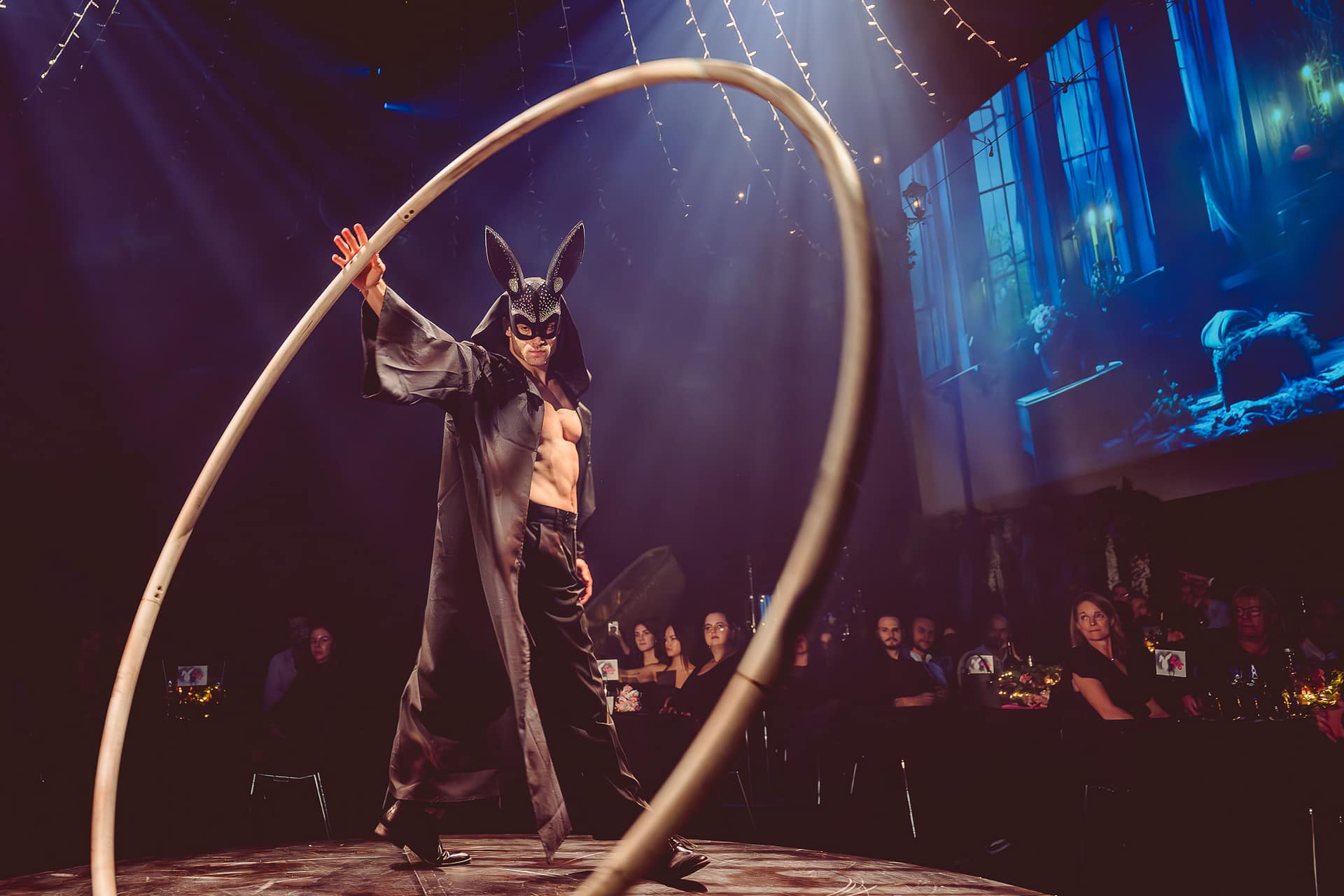
Cyr Wheel Act von Oscar Kaufmann im blauen Bühnenlicht

Which act suits a 1920s themed evening?

Themed evenings in twenties style live on characters, not disciplines. A purely technical act, however good, remains a foreign body in that setting.

Character acts are the obvious choice here, especially those with costume, posture and a recognisable figure. A gentleman in a suit losing his grip on gravity at a hat stand tells a story in seconds that fits the evening. Whip artistry works similarly well, combining elegance with controlled danger and slotting easily into the era stylistically.

A practical advantage of both: the humour comes from movement and timing, not from language. With an internationally mixed audience, that is decisive.

Cyr Wheel can also be adapted through costume and music, but remains the visually more modern act. For a vintage evening it is the second choice.

Which act suits a sports event?

Sports galas, awards evenings and gymnastics festivals bring an audience that can judge body control. That is both an opportunity and a risk: weaknesses show, but genuine technique is genuinely appreciated.

Cyr Wheel is the strongest choice here. The discipline grew out of wheel gymnastics and has its own world championship, so it connects naturally with a sporting context. It also works on large surfaces, which sports halls and arenas usually provide.

Aerial acrobatics works too, but requires a load-bearing rigging point, which sports halls do not always offer. If no point is available, a freestanding rig can be brought along.

For arena formats with lighting design and darkness, the LED Cyr Wheel is the most visually effective option, because it reads from a distance. That is an important difference from theatre stages: in an arena part of the audience sits far away, and fine detail is lost there.

Which act suits a modern event or brand moment?

At product launches, kick-offs and brand events, every programme point competes with the actual message. An act should therefore not only entertain but reinforce the brand.

Visual acts with programmable light are best suited to this. With the LED Cyr Wheel, colours, patterns, lettering and logos can be built directly into the wheel’s light programme. What the audience sees then does not look like a bought-in programme point, but visibly belongs to the presentation.

Two conditions apply: it needs to be dark enough, otherwise the effect loses its impact, and the enquiry should come early, because individual programming needs lead time.

If daylight is unavoidable, an act that works without light is the better choice, such as Cyr Wheel or juggling.

Which act suits receptions, trade fairs and formats without a stage?

Not every event has a stage, and not every audience stays seated. For receptions, exhibition stands and formats with ongoing activity, stage acts are the wrong choice, however good they are.

Walking acts and juggling have the advantage here. Walking acts move through the room, need no stage and no fixed start time. They create attention in waves rather than in a single peak. Juggling works in a small space, stays clearly visible and can be performed as a short stage number or in a walking format.

These are categories I do not offer myself. If your event calls for them, that is the more honest recommendation than a stage act that gets lost in the room.

What if the technical setup does not fit?

The most common obstacles and what can be done about them.

No rigging point available: for aerial acrobatics, a freestanding rig can be brought along and set up on site. The act then works independently of the ceiling structure.

Less than five metres of height: often still feasible. The character act on the hat stand needs only three metres, classic straps five. A quick enquiry with the exact measurements settles it faster than any table.

Small stage: Cyr Wheel has been performed on 2.40 metres in diameter. With adapted choreography, far more is possible than the technical ideal suggests. The only thing that matters is naming the measurements in advance, so the choreography can be adapted rather than improvised.

Unsuitable floor: carpet, large gaps and a noticeable slope are problematic for Cyr Wheel. Stage flooring, parquet and dance floors work well.

Outdoors: possible as long as the surface is level, dry and non-slip. In rain or strong wind the performance has to be moved or rescheduled for safety reasons. A backup plan therefore belongs in every outdoor plan.

Several acts in one evening

When an evening needs several programme points, combining different categories works better than three numbers from the same discipline. A ground act, an aerial act and a character act create three different kinds of tension.

There are practical arguments for booking several acts from one person: less coordination, one point of contact, one journey, and a common thread through the evening, because the same signature remains recognisable. Package pricing is available for multi-act bookings.

Frequently asked questions

Cyr Wheel. It works in daylight and in the dark, indoors and outdoors, on large and small surfaces, and needs no rigging point.

Acts whose effect comes from movement and timing rather than language. Character acts and aerial acrobatics work regardless of the audience’s linguistic background.

Between 20 and 60 minutes depending on the act. Ground acts are quicker, aerial acts need more time for rigging and safety checks.

A booking can be made at any time. The earlier the enquiry, the more likely your preferred date is still free. For individual logo programming, allow more lead time.

Costs are in the four-figure range. The main factors are travel, the number of performances and technical requirements.

You know your occasion, your room and your audience. Send me the date, location and event format, and I will recommend the right act and get you a concrete quote promptly.

Enquire about an act


The Best Cyr Wheel Artists – How to Spot a Great One

The Best Cyr Wheel Artists. What Makes a Great Cyr Wheel Show?

At first glance, Cyr Wheel looks simple: a ring, a person, a bit of momentum. Anyone who has held the apparatus themselves knows how misleading that first impression is. The difference between a solid act and an outstanding one is often hard for outsiders to spot, but for event organisers choosing who to book, it matters a great deal. The following article explains which elements are most important and mentions the most significant names of the scene.

A few criteria that tend to separate a genuinely good Cyr Wheel artist from the rest:

Cyr Wheel Künstler Oscar Kaufmann bei einem Auftritt im Cirque du Soleil Amaluna

Technique.

Clean lines, controlled transitions, no visible strain exactly where the movement is supposed to look effortless. Technique shows most clearly where something could go wrong and doesn’t.

Stage presence.

Technique alone doesn’t fill a room. An audience knows within seconds whether a performer is truly present or simply running through a routine.

Choreography that actually uses the stage.

A strong Cyr Wheel programme uses the full available space, not just the centre — diagonals, changes in level, deliberate closeness to and distance from the audience.

Flexibility between the smallest and largest stages.

An act that only works under ideal conditions is impractical for most real booking situations. The ability to adapt a choreography to 2.5 metres just as confidently as to 10 metres separates professionals from amateurs.

Professional communication.

Clear agreements before the event, a reliable technical rider, a point of contact who’s actually reachable on the day.

Solid preparation.

A well-thought-out sound check, a realistic schedule for set-up and rehearsal, and a backup plan if something doesn’t go as expected.

But whats a Cyr Wheel and where does this prop come from?

Anyone who brings all of that is worth watching

— and the international Cyr Wheel scene has a handful of names known for exactly that.
has been performing internationally for over ten years, including with Cirque du Soleil (Amaluna), at the Sydney Opera House, and at Wintergarten Berlin. His approach centres on choreography consistently adapted to whatever stage he’s given, from 2.5 metres in Manchester to large arena stages. Alongside the classic Cyr Wheel act, he also performs an LED version and The Flying Gentleman, a character act he developed himself. What sets him apart for organisers: consistent technical reliability across entire runs, clear upfront communication, and the ability to adapt to almost any stage situation, demonstrated through engagements at the Sydney Opera House, in Cannes, and currently at Hansa Theater Hamburg and Rhypark Basel.

Hauke Narten

is widely regarded as one of the most technically skilled Cyr Wheel athletes in the world. A multiple-time Cyr Wheel World Champion (including 2018 and 2022), he currently serves as IRV Head of Cyr, overseeing the discipline’s international development. His focus lies primarily on competitive Cyr Wheel, with striking technical command across large surfaces.

Lea Toran Jenner

has built one of the best-known careers in the scene over the years. Trained at the renowned circus school in Montreal, she was hired at the Moulin Rouge in Paris in 2017 and has returned there repeatedly ever since. She’s especially known for “Duo Unity,” her Cyr Wheel duo act with Francis Perreault, as well as, more recently, her own solo career and a substantial social media following. In 2024, she also became Cyr Wheel World Champion.

Marica Marinoni

represents a very different, contemporary approach to the Cyr Wheel. A graduate of CNAC, France’s renowned national circus school, she has notably advanced the apparatus’s movement vocabulary, with unusually fluid transitions and a physical expressiveness that often deliberately departs from the classic show format. Rather than the usual five minutes, her pieces frequently run considerably longer, following the logic of contemporary dance theatre more than a traditional variety number.
can’t be left out of this list — he invented the apparatus in the early 2000s and gave the Cyr Wheel its name. He no longer performs actively today, but without his work, the entire scene as it exists now simply wouldn’t be there.

Looking for a Cyr Wheel performer for your event? Oscar performs internationally for galas, TV productions, theatre, and corporate events. [Enquire now →]

What Are Aerial Straps?

What are aerial straps?

Aerial straps are two long fabric straps hanging from the ceiling or a rigging point. The performer wraps their hands and wrists into the straps and performs elements powered entirely by upper body strength — spins, balance holds, and transitions supported solely by the arms, with no additional bracing.

What is aerial acrobatics in general?

Aerial acrobatics refers to any acrobatic discipline performed above the stage from a rigging point, including straps, trapeze, aerial silk, and rings. What unites them all is the combination of strength, balance, and the visual impact of height.

How are aerial straps different from other aerial disciplines?

Unlike trapeze or aerial silk, where you can wrap or brace against fabric, straps rely almost entirely on grip technique and pure upper body strength. This makes it one of the most physically demanding forms of aerial acrobatics, since every movement is held directly through the wrists.

What does a professional straps act look like?

A strong straps act lives on contrast: fast, powerful spins alternate with slow, almost weightless holds. Music and lighting play a central role in building and releasing tension throughout the piece.

Who am I as a performer?

I’ve performed aerial straps internationally for over ten years, including at the Sydney Opera House, Wintergarten Berlin, and GOP Varieté productions. Alongside solo performances, I also offer creative development, from first concept through to a stage-ready act. [Learn more →]

15 +

Years performing internationally

1

Signature-Akt, One of a kind

30 +

Countries on stage

5

Distinct bookable acts

Frequently Asked Questions

Yes. Straps is one of the most strength-intensive aerial disciplines, since nearly every position is actively held through grip technique.

Trapeze has a fixed bar to rest on. Straps has no fixed structure at all — everything is held through the straps themselves.

Yes, I offer Workshops for beginners and advanced artists. [See workshops →]

A minimum 5-metre rigging point is recommended with 250 kg working load.

An act with many dynamic and strength based tricks might take years if not centuries to master. 

I perform internationally for galas, theatre, cruise ships, and corporate events. [Enquire now →]

Reach or Real Connection — What Actually Matters on Stage?

Reach or Real Connection — What Actually Matters on Stage?

As a circus artist, I perform on very different stages. Two of them this week made me think.

Last week: Italian television. Beautifully lit studio, professional crew, everything running on schedule. Millions of people watching — somewhere out there, behind a camera lens. No eye contact. No reaction. No connection.

This week: Fete Magique in Belgium. Beautiful chaos. Sweat, laughter, artists sleeping next to their props, audience close enough that you can watch their faces change mid-act. Exhausting, alive, intimate.

Two worlds, one profession

A television appearance as a circus artist is a different discipline. The camera replaces the audience. You perform into a room without feedback, without energy coming back. What counts is the image — precision, timing, visual impact. The rest is editing.

A festival like Fete Magique is the opposite. The act starts before you reach the stage. Guests are standing a metre away. When a child in the front row stops blinking, you feel it. When someone comes backstage afterwards just to say thank you, that isn’t a comment on social media — that is a moment.

What stays with you

Reach has real value. A TV appearance finds people who would never walk into a variety theatre. That matters. But depth is something else. The question isn’t which format is better — both are part of the work of a professional performing artist. The question is what you take home with you afterwards.

I think longer about the moments when something actually happened. They were rarely on the biggest stages.

Oscar Kaufmann is a circus artist and Cyr Wheel performer based in Berlin. He performs internationally — on television, at festivals, in variety theatres, and at corporate events. Booking enquiries: info@oscar-kaufmann.de

Cannes, Summer 2025: Six Weeks of LED Cyr Wheel at Annex Beach Club

Annex Beach Club in Cannes is not a typical venue. A luxury outdoor restaurant on the Mediterranean, golden-hour sunsets, guests who are used to the finest things. Exactly the kind of environment where an act either delivers — or visibly doesn’t.

It was my first extended run with the LED Cyr Wheel. Multiple shows per week across six weeks. I knew the wheel worked technically. But sustained back-to-back performances are a different kind of test: would the equipment hold up night after night?

It did. Not a single failure across the entire season. Every show ran in sync with the music and stage lighting — on a stage just three metres across, the technical minimum for this act. You learn quickly to own every centimetre of the space.

Timing was everything. The evening programme opened with sunset, but the LED act always closed it — waiting until dark enough that the light truly lands. Too early and the contrast is gone, the effect disappears. Patience is part of the performance.

What surprised both the venue owners and the guests: building the Annex logo and custom graphic patterns directly into the LED programme. Not as a gimmick, but as a statement — this act belongs to this evening, to this place. Guests who are used to seeing world-class entertainment still said they had never seen anything like it.

My intention from the start was to use light as a design tool rather than decoration. No flashing for the sake of flashing. Cannes confirmed that the approach works — and that the act is ready for long-term contracts at the highest level.

Booking enquiries: info@oscar-kaufmann.de

September 2025


“Pink Rabbit” in Zürich

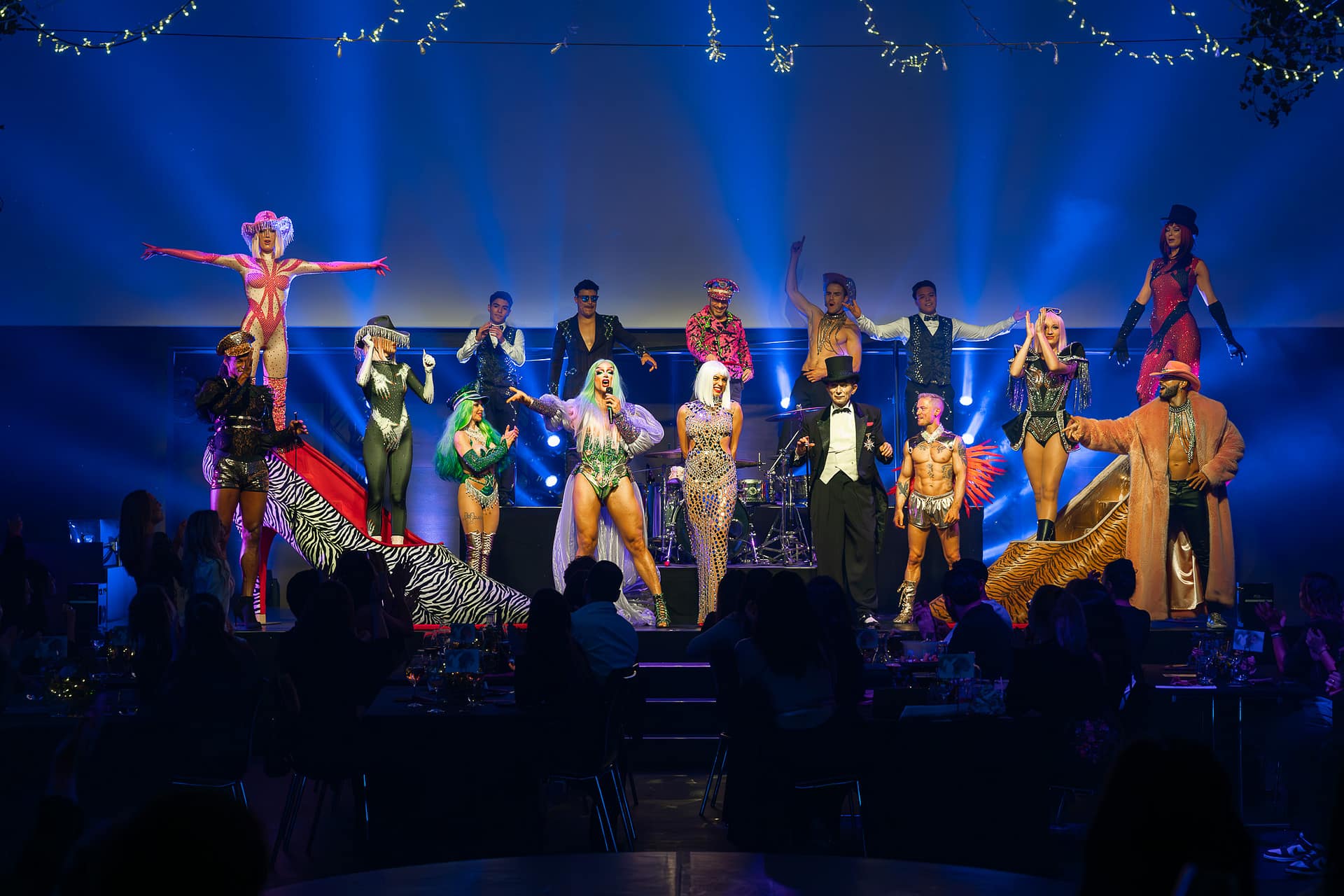
From October to November, Zurich became the stage for the dinner show “Pink Rabbit”. In three and a half hours, we offered a mix of acrobatics, choreography, and immersive theater – a feast for all the senses.

At the entrance, we welcomed guests in elaborate costumes, ready to transport them into another world. Our talented cast presented sophisticated, sensual choreographies that captivated the audience.

I opened the show with aerial straps, later performed as the hat stand, and amazed in the finale with the Cyr wheel. The grand finale was delivered by our drummer Ivan, who thrilled the crowd with his energetic performance.

After the finale, the show seamlessly transitioned into a party, where guests celebrated and enjoyed the unique atmosphere. “Pink Rabbit” was more than just a show – it was an unforgettable journey into another world.

The Link to the Show!

January 2025

“Gatsby at the Green Light.” at the Sydney Opera House

It was an exhilarating time for me as I arrived in Sydney in November for three weeks of rehearsals for the new show “Gatsby at the Green Light.” The premiere took place on December 16, 2023, and it was a true privilege to be part of this production.

The show was hosted at the famous Sydney Opera House, an iconic landmark and theater known worldwide for its beauty and cultural significance. It was a great honor to perform in this renowned theater.

The cast of “Gatsby at the Green Light” was outstanding, and it was inspiring to collaborate with such talented artists. The show brought together not only circus acts but also a lot of dance, burlesque, and theater, creating a diverse and captivating experience for the audience.

Our renowned director, Craig Illot, had devised a special concept for the show. The bar of our “club” became the stage, and the waiters served the final signature drinks before starting to dance in the midst of the audience. It was an immersive experience that allowed the audience to dive directly into the world of Gatsby.

The performances took place eight times a week, and each show was unique and exciting. It was an unforgettable time for me, and I am grateful for the opportunity to be part of “Gatsby at the Green Light” at the Sydney Opera House.

Link to the Show!

März 2024

“La Clique” at Edinburgh Fringe Festival

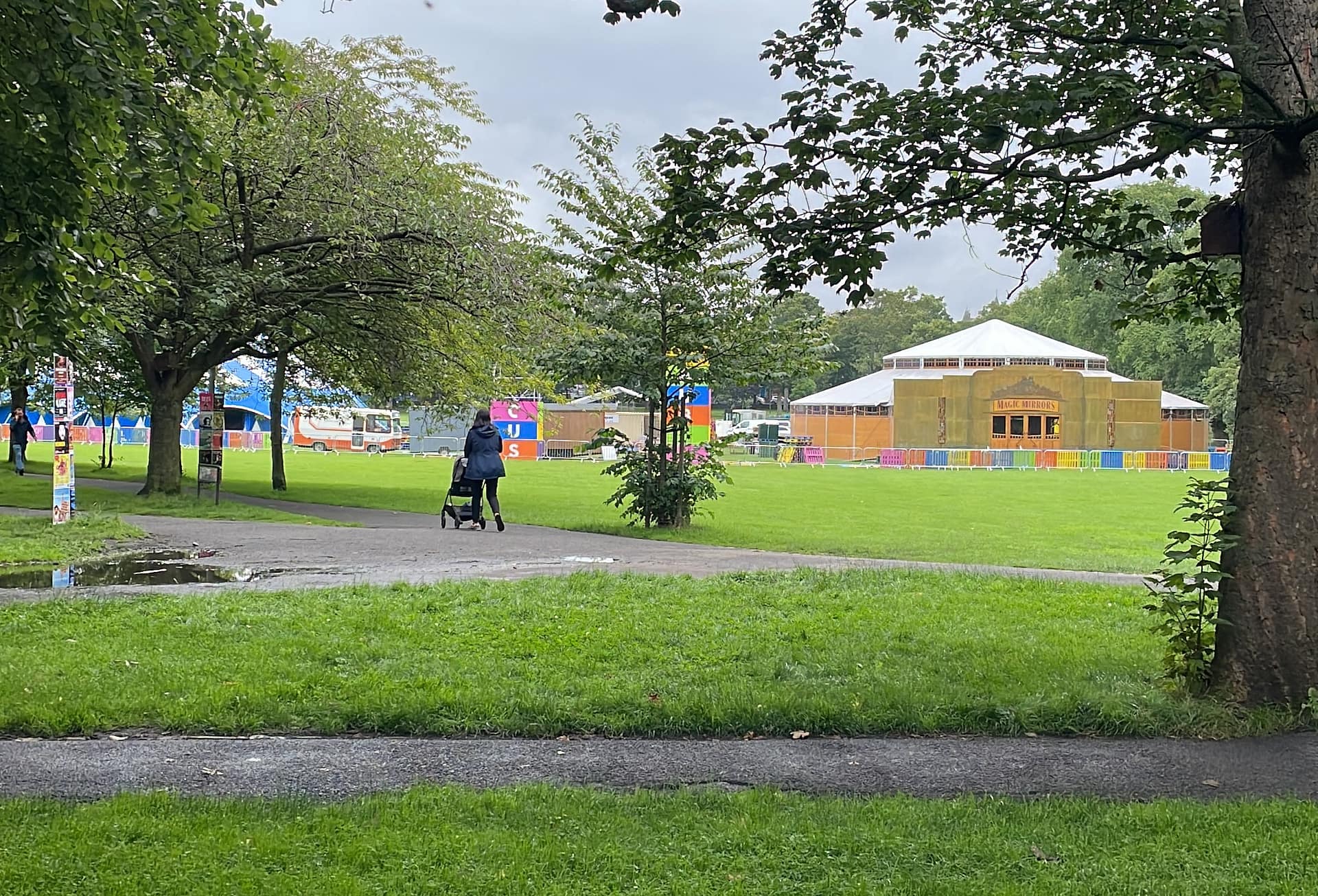
The entire month of August was an exciting chapter in my career as I was part of the “La Clique” show in Edinburgh at the world-renowned Fringe Festival. The show was also produced by Underbelly, and they created a wonderful venue in the Meadows, a vast park, with two tents and a large bar.

Our run was a great success, and it was fascinating to witness the shows sold out from the first to the last day. We consistently had over 600 loud and enthusiastic guests in the audience who thoroughly enjoyed the performances.

The Edinburgh Fringe Festival is an impressive event with over 3000 shows taking place in hundreds of venues and theaters. In our Spiegeltent alone, there were five shows every day. It was inspiring to be part of this creative and vibrant festival.

During my time in Edinburgh, I had the chance to meet many friends and acquaintances. While each day could end at the bar, I spent most of my time attending other performances before and after our show. In total, I saw over 60 shows during the festival, which was an incredible experience.

August 2023

“La Clique” in Manchester

From May 26th to July 29th, 2023, I had the pleasure of being part of the “La Clique” show in Manchester, and it all took place on the rooftop of Depot Mayfield. The show was produced by Underbelly, and they created a fantastic venue for the guests, complete with bars, seating, and a beautiful Spiegeltent – on the smallest stage I’ve ever performed on.

The world-famous, mere 2.5-meter-diameter red stage presented a unique challenge. Here, I even showcased my Cyr Wheel skills, getting perilously close to the audience. It was a breathtaking experience to be in such an intimate setting, in direct contact with the spectators.

Particularly, the Hat Stand act thrived in this proximity and fit perfectly within the classic vintage Spiegeltent. The atmosphere of the tent and the vintage aesthetics added a touch of nostalgia.

The audience was notably young, eager for entertainment and ready to have a good time. It was an honor to experience these thrilling nights at Depot Mayfield and connect with so many enthusiastic viewers.

July 2023

More News...