Hiring a circus performer without surprises
Looking to book a circus artist for your event? Great choice. Circus arts create moments guests talk about long after the evening ends, and they work without words, for any audience.
If you rarely book acrobatics, though, you will face questions that never come up with a band or a DJ: How high does the room need to be? What is a rigging point? Why does the floor have to meet certain requirements? And which taxes or levies apply? This guide takes you through the booking step by step, from the first enquiry to the applause.
What to include in your first enquiry
The more complete your first enquiry, the faster you will receive a reliable quote. If something is missing, that is fine; it just takes one more email. These details help the artist assess availability, technical needs and effort straight away:
- Date and time (approximate is fine)
- Location: city, venue, indoors or outdoors
- Occasion: gala, corporate party, client event, trade fair, conference, themed evening
- Audience: approximate number of guests, language(s), seated or standing
- Stage: dimensions (width × depth), floor surface, stage height
- Ceiling height and rigging point: is there a certified hanging point, and how high is it?
- Lighting: can the room be darkened, is there stage lighting and a lighting technician?
- Slot in the programme: opening, highlight, transition, late evening; planned show length
- Number of performances per day
- Requests: branding, music, costume colour, theme
- Budget range (a rough one is enough)
- Contact person with phone number
Sharing a budget range is not a weakness in negotiation. It helps the artist suggest the right format straight away, for example one act instead of two, or one show instead of three.
What makes up the fee
There is no price list for acrobatics that fits every event. A single evening in Berlin looks different from a run of several weeks or a performance that involves international travel. These elements shape the fee:
- The show: the performance itself, meaning the act, its length and the number of artists
- Rehearsals: for a single show, a rehearsal on the day is usually enough. Dedicated rehearsal days, for example for a fully staged opening ceremony, are charged separately.
- Travel and accommodation: travel, flights, luggage for props and, for events away from the artist’s home city, usually one night in a hotel
- Branding and customisation: custom music, costume colours, a theme or, with the LED Cyr Wheel, the company logo in the light programme. This needs preparation and lead time.
- Several shows per day: at trade fairs or long events, multiple performances are common. Each extra show adds to the fee, though usually not as much as a second booking.
- Several acts: booking more than one act from the same artist often comes with a package price, since travel and organisation happen only once.
- Usage rights for filming: a recording for your internal archive is different from a commercial, a TV broadcast or clips for social media. What will be filmed and how it will be used belongs in the quote.
Between businesses, fees are usually quoted net, plus VAT. Depending on the case, levies may apply on top that are not part of the fee (more on this under “Levies many organisers forget”).
Understanding the technical side
Technical requirements are where most misunderstandings happen, yet the questions are manageable.
Stage size
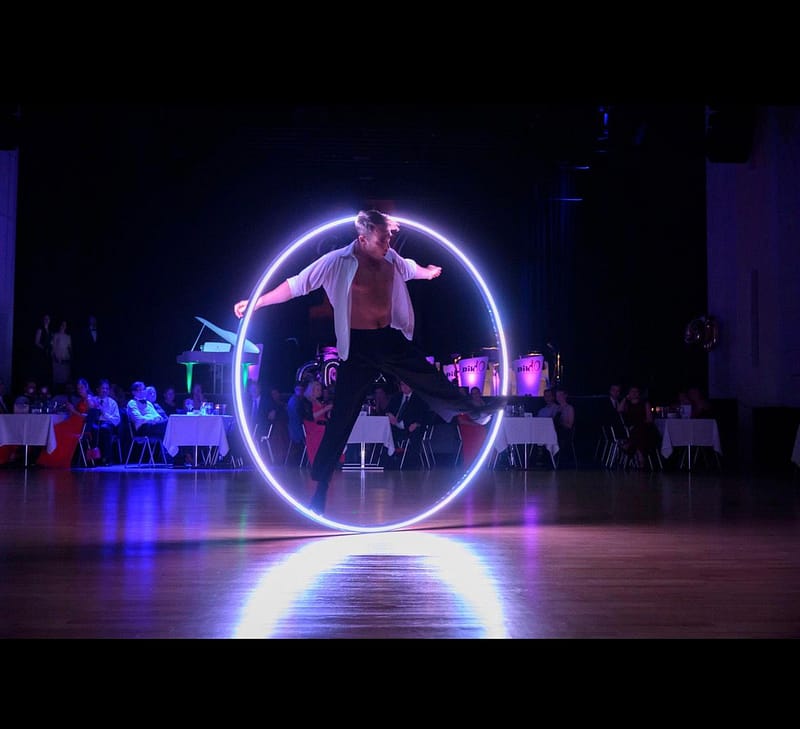
Every act needs clear floor space. Clear means free of lecterns, microphone stands, decoration and flowers. A classic Cyr Wheel, for example, needs about 5 × 5 m, while the LED Cyr Wheel works on a round stage of 2.8 m in diameter. Some distance from the audience is part of it, and for a whips act this is a safety distance.
Floor
Floor-based acts need a level, solid, non-slip surface. Carpet, loose panels or a wet terrace will not work. A stage built from platforms must be firmly connected and must not bounce.
Height and rigging point
Aerial acts hang from a rigging point: a certified hanging point on the ceiling or on a truss. What matters is height and load capacity. Aerial straps, for example, need a point from 5 m with a load capacity of 250 kg, while an act like The Flying Gentleman works from 2.8 m. The venue’s in-house technicians will know whether such a point exists. In halls and theatres, a rigging service often installs it.
Freestanding rig
No rigging point does not mean no aerial act. Some artists bring a freestanding rig. The rig used for the aerial straps and The Flying Gentleman, for example, stands on a footprint of 5.1 × 5 m and is up to 5.4 m high. The room therefore needs enough height, and the area has to stay clear.
Lighting
Stage lighting makes acrobatics visible. LED acts have one special requirement: the light in the prop only works at dusk or in the dark. In a bright room, in daylight or under full house lights, very little of the light show comes across. For an outdoor event, that means scheduling the act after sunset.
Music and sound
Most acts run to a fixed piece of music. The artist sends the file in advance; on site you need a sound system and someone to start the track on cue. Live music is often possible but needs to be agreed with the band and rehearsed.
The technical rider
A technical rider is a short document listing everything the act needs: floor space, surface, height, rigging, lighting, sound, dressing room, set-up and strike time. It is the checklist for the venue and forms part of the contract. Pass it on to the venue’s technicians early, so any gaps show up while there is still time.
)
What belongs in the contract
A written contract protects both sides. It does not need to be long, but it should clearly cover:
- Performance: which act, how many shows, how long
- Times: arrival, set-up, rehearsal, show time, strike
- Rehearsal: when, where and how long, with which lighting and sound
- Cancellation and illness: what happens if the artist cannot perform? Is there a second cast or an equivalent replacement? What applies if the organiser cancels?
- Weather for outdoor events: rain, wet surfaces or strong wind make acrobatics outdoors unsafe. The contract should state who decides on moving the show, where it moves to and what happens to the fee.
- Insurance and liability: does the artist have liability insurance? Is the event covered by the organiser’s liability insurance?
- Payment: amount, due dates and deposit. A deposit on signing is common, especially for a first collaboration.
- Travel, accommodation, catering: who books and who pays
- Photo and video: what may be recorded and how it may be used
- Taxes and levies: whether the fee is agreed net or gross and who bears which levy
Levies many organisers forget (events in Germany)
If your event takes place in Germany, a few obligations apply to the organiser that have nothing to do with the fee itself. They are often noticed only during an audit.
Artists' social security levy (Künstlersozialabgabe, KSK)
Companies in Germany that engage self-employed artists often have to pay the artists’ social security levy on the fee to the Künstlersozialkasse. This applies not only to event agencies and promoters, but also to companies using acrobatics for their own purposes, such as a corporate party, a client event or a trade fair stand. For such companies, the obligation applies once payments to self-employed artists exceed the annual threshold, which is 1,000 euros from 2026. The rate is 4.9 per cent in 2026 and has been set at 5.0 per cent for 2027.
Good to know:
- The levy applies whether or not the artist is insured with the KSK, and also to artists based abroad.
- It is calculated on the total fee including expenses. Separately invoiced VAT and travel costs reimbursed within the tax-free limits are excluded.
- Private celebrations such as weddings or birthdays are exempt.
- The levy may not be deducted from the artist’s fee. Such agreements are void.
- If an agency contracts the artist in its own name, the agency is usually liable. If it acts only as the artist’s representative, the obligation stays with the organiser.
Withholding tax for artists from abroad (Section 50a German Income Tax Act)
If an artist has neither a residence nor a habitual abode in Germany, the organiser must withhold tax from the fee for a performance in Germany. The rate is generally 15 per cent of the fee plus a 5.5 per cent solidarity surcharge on that amount. The organiser files and pays it to the Federal Central Tax Office (BZSt) by the 10th of the month following the end of each quarter. This also applies to artists from other EU countries. No tax is withheld if the fee does not exceed 250 euros per performance.
If the deduction is missed, the organiser is liable. An exemption under a double taxation treaty is possible, but only if the BZSt exemption certificate is already in hand when the fee is paid; an application alone is not enough. If the fee is agreed “net”, meaning the artist receives it in full, the organiser bears the tax on top and a higher rate applies. That is why this belongs in the contract.
VAT: reverse charge
When an artist based abroad invoices a business in Germany, the business usually owes the German VAT rather than the artist (reverse charge, Section 13b German VAT Act). The invoice is then issued without German VAT and with a note to that effect.
Note: this section gives an overview as of October 2026 and does not replace tax or legal advice. Binding information comes from the Künstlersozialkasse, the BZSt and your tax adviser.
Sources: Künstlersozialkasse: who is liable, KSK: assessment basis, KSK: information sheet no. 4 for organisers, Federal Ministry of Labour: rate for 2027, BZSt: withholding tax rates, BZSt: FAQ on withholding tax, Section 13b German VAT Act
The day of the event
On the day, organisation decides whether the performance lands the way it was planned.
- Arrival: the artist usually arrives a few hours before the show. Set-up takes 20 to 60 minutes depending on the act; aerial acts take longer because rigging and safety checks are part of it.
- Rehearsal: on stage, 15 minutes is often enough to align lighting, sound and cues. Aerial acts and acts with a prop on a rigging point need more, around an hour. What matters is that the lighting and sound technicians are present.
- Dressing room: a heated, clean room to change and warm up, ideally lockable, with a mirror and good light. Water and a light snack are customary. A toilet without a mirror or a storage room will not do.
- One contact person: someone on site who knows the schedule and can make decisions. With a mobile number, not just an email address.
- Time buffer: speeches run long, dinner is served late. Artists warm up before they perform and need a reliable start time. Announce delays early, ideally with a new fixed time.
- Running order: a written schedule with times, the host’s introduction, music and lighting cues and the moment the stage must be clear. Share it with everyone involved: technicians, host, catering and the artist.

Common mistakes
Most problems with acrobatics at events are predictable. These five come up most often:
- The stage is too small. It was big enough on the plan, but on the night it holds a lectern, flowers and a grand piano. Clear floor space means clear.
- The act runs at the wrong time. During dinner, guests sit with their backs to the stage, waiting staff walk through the picture and cutlery clatters. Better moments are between courses, after the main course or as the highlight of the evening.
- The lighting is too bright. An LED act under full house lights or in daylight loses its effect. Check in advance whether the room can be darkened.
- No rehearsal planned. Without a rehearsal, the technicians do not know the cues and the artist does not know the stage. A short rehearsal saves a lot of nerves later.
- Height and rigging not checked. A ceiling “of about 6 metres” is not clearance for an aerial act. What counts is a certified point, its load capacity and the clear area below. Ask the venue’s technicians early, or plan for a freestanding rig.

Book the artist directly or through an agency?
Both have their place. Which suits you better depends mainly on how many acts you are looking for.
Directly with the artist
For one or two acts, booking yourself works well. You talk to the person who will be on stage, technical and scheduling questions are settled without detours, and there is no agency fee. Many artists also advise on choosing the right act and will say honestly when another act would suit better.
Through an agency
Once several acts, a host, music and technical production need to come together, communication becomes demanding: many quotes, many contracts, many riders. An agency takes on this coordination and has a network of performers it works with reliably. For a complete show programme, that is often the easier route. The agency’s service is included in the price.
A simple rule of thumb: one or two acts directly, a full programme with many people involved through an agency.
Frequently asked questions
As soon as the date and venue are fixed. For galas and corporate events, a few months’ notice is common. Short-notice bookings are possible if the date is free; only branding, custom music or a new light programme need more time.
It depends on the act, the number of shows, travel and technical requirements. A reliable quote follows an enquiry with date, location and occasion. Flat price lists rarely fit, because events differ so much.
Often, yes. Companies in Germany that engage self-employed artists usually pay the artists’ social security levy (4.9 per cent in 2026) once payments exceed 1,000 euros a year. Artists based abroad may also trigger a withholding tax. The Künstlersozialkasse or your tax adviser can give binding information.
A list of all technical requirements of the act: floor space, surface, height, rigging point, lighting, sound, dressing room and set-up and strike time. It forms part of the contract and should reach the venue’s technicians early.
Yes, on a level, dry and non-slip surface. In rain or strong wind, a performance has to be moved or postponed for safety reasons, so always have a plan B. LED acts only work outdoors after sunset.
The contract covers this. Some acts have a second cast who can step in at the same level. Ask about it when booking and put the arrangement in writing.
Planning an event and want to enquire about an act? The contact form below is all you need to start: date, location and occasion are enough, the rest can be clarified afterwards. To find the act that suits your event, read Which Show Act Suits My Event?. For trade fairs and conferences, see Show Act for Trade Fairs, Expos and Conferences, and for corporate events and galas, Show act for corporate events and galas.


